The Sawai International Koto School presents: Winter Koto Concert
When: Saturday 16th June 2007 7.30pm for 8pm start
Where: St Stephens Church Hall Church Street, Newtown
Koto Performers: Catherine Brown, Dwight Dowda (and Michael Field on flute), Moko Eade, Anne Grantham, Miyama McQueen-Tokita, Shoko Ono, Mizuno Oyuki, Miko Wilkin
Director: Satsuki Odamura
Admission free, Donation at door would be appreciated
Contact: Shoko Ono shoko.ono-1@uts.edu.au 0402 655 851
Monday, 28 May 2007
Tuesday, 8 May 2007
Raw
 This afternoon I recorded Koku with passing buses and car horns [for the purposes of observation and subsequent reference]. It is still very rough but I am working on the flow and certain ornamentations to achieve greater simplicity. Hopefully, the sound will become more refined with practise. Yesterday, my double CD album of Yokoyama Katsuya 'Zen' arrived from Amazon. I am not sure why I have not this earlier! Of course it includes Koku and, in this case, played on flute-length closest to my own. My 2.1 has a 'B' fundamental and Yokoyama is using an approximate 'A#' - is that 2.2? Somehow, with so many things to think about, Koku feels very energetic when I play it but Yokoyama makes it sound perfectly serene and with superlative long phrases ...

Saturday, 5 May 2007
Blue Mountains excursion
 Yesterday was a beautiful crisp autumnal yet sun-filled day for Kevin [Melville] and I to take an excursion by train to Katoomba for shakuhachi lessons with Bronwyn (my first since the arrival of her new baby and hence a chance to meet Alina). Kevin was working on Honshirabe and I was struggling with Koku. It was very fruitful in terms of refreshing and learning more about the detail of the piece and its flow. I like this piece very much but I also find it the most difficult I have studied to date because of its fairly insistent intense high register and powerful, often explosive raw undercurrent while overall 'emptiness/serenity': an interesting concurrence. Technically, it contains many fine subtleties and requires utmost accuracy of pitch (of course every piece does but this one weaves around considerably). Both Kevin and I observed Bronwyn's uncanny calm and concentration despite occasional cries from Alina in the adjacent room. Overall, the composite of scenic train journey, nice Niche Nosh at the vegetarian cafe and beautiful outlook around Bronwyn's and Katoomba in general, made it a delightful one-day excursion: the seemingly long 10-hour excursion for a shak lesson turned out to be very enjoyable!
 From komuso.com, "Kokû (Dokyoku) is a Koten piece from the Dokyoku school (founded by Watazumi Doso Roshi in the 1950's)" and ‘Empty Sky’ is a ubiquitous translation of Koku. This piece, transmitted through the Watazumi/Yokoyama lineage of shakuhachi, is one of many versions of 'Empty Sky', which is one of a trilogy of the oldest and venerated honkyoku, the other two being ‘Empty Bell’, and ‘Flute on the Misty Ocean,’ i.e. (in the Fuke set repertoire): Kyorei, Mukaiji, and Koku. These works are collectively referred to as the Koden Sankyoku. They are respected as the oldest works and transmitted in all branches of shakuhachi playing. "The work is in three part form: calm-movement-calm. Even though it is a very long piece it is very well organized. In each part various techniques are developed. According to legend, Kyochiku (literally, ‘empty bamboo’), a Zen priest who founded the Myoan temple in Kyoto in the thirteenth century, fell asleep while practicing shakuhachi inside the temple at Ise. He dreamed of a solitary boat floating on a misty sea and heard a strange sound from the heavens. As the mist gradually disappeared, another sound reached his ears. Awakened, he immediately transcribed the mysterious sounds into the sounds of his bamboo instrument, thus creating three pieces: Koku (Empty sky or ‘Vacuity’), Kyorei (Empty bell), and Mukaiji (Misty Sea)."
 Apropos tone production [and requisite emptiness] "let go of sound and focus on the process" [Bronwyn]

 Kevin (silhouette with the Eucalypts) and Bronwyn. The colour and resolution of these images look much better at Flickr.
Saturday, 14 April 2007
Easter holidays in Oberon
 I am fortunate to be able to 'escape' for breaks to the country. My intention was to practice [shakuhachi] quite a bit but naturally the scenic surroundings also caught my attention, ranging from the prolific wood fungus growing on sawn-off pines while running in the forest to the wind farm at Blayney driving to Cowra, small country villages in drought-stricken rural NSW, the autumnal colours of changing poplars and red deciduous trees and gorgeously alive sounds of frogs, birds and other wildlife on the farm.


Tuesday, 10 April 2007
Cowra Japanese Garden in NSW, Australia

 With Mum and Dad, I took a (nearly 3 hour one-way) drive through country NSW from Oberon to to Cowra Japanese Gardens. Designed by Ken Nakajima in 1971, opening 1979, the gardens commemorate the Cowra POW breakout and long association of Cowra with Japanese immigrants to Australia. Somehow this deplorable time in Australia's history has been transformed into something very beautiful. In addition to the stroll garden pictured, there is a rock (and pebble) meditation garden, bonsai house, pottery and in season a Sakura Matsuri! www.cowrajapanesegarden.com.au/ and more photos here Flickr/
Monday, 9 April 2007
Running and walking around Sydney Harbour
 I recently started running again (and sometimes walking), mostly in the early mornings. This is supposed to increase my phrase-length on shakuhachi! I am very fortunate that this often takes me to some of the most picturesque locations on Sydney Harbour's northern foreshore. For the benefit of my overseas friends, I am including here some pictures from around Lavender Bay, Milsons Point and Kirribilli. Other times, I run down to the water at Balls Head Reserve in Waverton and Berry Island Reserve in Wollstonecraft, incorporating a very hilly but scenic course including many natural bush regeneration areas and quiet roads. In Oberon, I ran in the paddocks and along dirt forestry roads through the pine trees and sheep (and managed not to disappear down a wombat hole!)
Sunday, 18 March 2007
Suburban soiree
 This afternoon at Kevin's leafy suburban home with magpie and lorikeet accompaniment we had green tea, a short ro-buki practice and I played Shingetsu before we exchanged experiences and progress over lunch at sushi-ya. Shingetsu was one of the pieces we started learning at the Hawaii Shak Festival taught by Furuya, Matama and Kakizakai. It is the first piece I have studied using komibuki wave-like pulsating effect. This piece about mind/spirit or enlightenment and other-worldiness as encapsulated by the moon. Furuya told us to think of a tranquil lake with the gentle rippling reflecting the moon-rays. It has to be so simple and transparent that it is very difficult. I like very much listening to my two recordings of this piece by Furuya and Kakizakai because they are so different yet both so beautiful: Furuya maintaining the gentle pulsating and a certain lyricism; Kakizakai drops the komibuki technique altogether in order to capture the exquisite purity and sincerity without any form of ornamentation, breathtakingly serene in the high soft passages. This is taking me a long time to gain enough control to emulate the gentle high register in a very understated way.
It is quite encouraging and motivating to get together.
Saturday, 24 February 2007
Hyper-shaku at Creativity and Cognition '07
 Written with Sam Ferguson, our paper, Gestural Hyper Instrument Collaboration with Generative Computation for Real Time Creativity has been selected for the Creativity and Cognition Conference (Seeding Creativity: Tools, Media, and Environments) in Washington D.C. with keynote speakers Mitchell Resnick from MIT Media Lab and Thecla Schiphorst from Simon Fraser University. We are quite chuffed because only 24 papers were chosen. Sam will present the paper as I will be in Japan at that time. This paper describes an environment for creative engagement utilising idiomatic musical performance gestures and expression to elicit responsive generative augmentation of audio and visual delivery. The system employs artificial biological systems to generate new artistic material meshed with musical performance. The generative process is triggered and moderated by the gestural interaction of the human performer (sensed by motion captors, computer vision and computer hearing). The model’s scalability and modularity enable different generative processes to be interchanged to explore the affect of their interaction with each other and responsiveness to the performer. Technical implementation is demonstrated in the environment, Hyper-Shaku.
Tuesday, 13 February 2007
Nihongo Kurasu
 Of course I finally have to try to learn Japanese language! In the holidays I spent two weeks in an intensive beginners class (Continuing Education at Sydney University) and 3 weeks ago we started level 1 following on. The virtues of non-declining verbs, 2 tenses, absence of singular and plural are just wonderful compared with the European languages I have studied previously. I guess the script and particles are going to make up for it but so far very fun with our invigorating teacher, Mayumi Sensei. So far just meet & greet, endless different techniques for counting of different objects, shopping terminology, business hours, cards, professions, transportation. The teaching is very inspiring.
Friday, 9 February 2007
Youkobo Art Space Tokyo Residency
Youkobo Art Space is located in metropolitan Tokyo, 15km west from the city centre, near to Kichijoji Station. It consists of a gallery space, 2 studios and 2 apartments, one each Japanese and Western style equipped with heating, appliances, cooking utensils, LAN Internet access, a bicycle, etc. The co-directors are Hiroko (sculptor) and Tatsuhiko Murata who have welcomed over 70 artists of 15 different nationalities since founding Youkobo Art Space in 1984. Youkobo Art Space's primary objective is to support and enhance the creativity of artists by offering opportunities for artistic investigation on urban issues in a contemporary Japanese setting. Its various programs are committed to providing the local community with creative stimulus by promoting cultural exchange between international artists and local citizens.  I have been invited from December '07 to January '08 to undertake two proposed projects: a responsive sound & video design performance environment; and composition of a shakuhachi and koto double concerto integrating traditional and contemporary idioms. The responsive sound & video design performance environment, InterTOKYO will use real time generative music, images and sound collected in the Tokyo neighbourhood and sounds derived from shakuhachi original sounds together with gesture tracking computer vision and wireless sensing to trigger exploration by subtle gestures of the shakuhachi performer. In the end, the piece is intended for multimedia performance in 2008 World Shakuhachi Festival but I will trial performance at Youkobo, where it should be a thought-invoking locative piece to facilitate community engagement. Collecting its material involves photographic, audio recording and video exploration of the neighbourhood, following the theme of 'finding Zen in modern Japan', a junction epitomised by Tokyo, examining the clash/fusion/collaboration/complementarity/co-existence of the Traditional and technology, assimilating the physical and digital in an aesthetic environment. In preparation for the composition, I hope to collaborate with and seek advice from Kakizakai and to audit some traditional music sessions at the Tokyo Geijitsu Daigaku (Tokyo University of Fine Arts), recommended to me by Tom Heneghan at work [his former University].
 I have been invited from December '07 to January '08 to undertake two proposed projects: a responsive sound & video design performance environment; and composition of a shakuhachi and koto double concerto integrating traditional and contemporary idioms. The responsive sound & video design performance environment, InterTOKYO will use real time generative music, images and sound collected in the Tokyo neighbourhood and sounds derived from shakuhachi original sounds together with gesture tracking computer vision and wireless sensing to trigger exploration by subtle gestures of the shakuhachi performer. In the end, the piece is intended for multimedia performance in 2008 World Shakuhachi Festival but I will trial performance at Youkobo, where it should be a thought-invoking locative piece to facilitate community engagement. Collecting its material involves photographic, audio recording and video exploration of the neighbourhood, following the theme of 'finding Zen in modern Japan', a junction epitomised by Tokyo, examining the clash/fusion/collaboration/complementarity/co-existence of the Traditional and technology, assimilating the physical and digital in an aesthetic environment. In preparation for the composition, I hope to collaborate with and seek advice from Kakizakai and to audit some traditional music sessions at the Tokyo Geijitsu Daigaku (Tokyo University of Fine Arts), recommended to me by Tom Heneghan at work [his former University].
Monday, 5 February 2007
Zen priests of nothingness on ABC Radio National
 Geoff Wood will broadcast a documentary in his Encounter series on ABC Radio National (Australia) featuring the background and music of the komuso monk. Inspired by his visit to Myoanji Fukuji Temple of Light and Darkness in Kyoto, where the remaining monks in the tradition of the mendicant Fuke sect remain, Wood visited guided by Kyoto shakuhachi master, Kurahashi sensei. The radio program will include Katsuya Yokoyama (Tokyo), Yoshio Kurahashi (Kyoto), Ronnie Nyogetsu Seldin (New York), Christopher Yohmei Blasdel (Tokyo) and Riley Lee (Sydney). 'Zen Priests of Nothingness': Sunday 1 April 2007, 7:10am; repeated 4 April, 7:10pm. This program will be online for MP3 download for 4 weeks following the broadcast at http://www.abc.net.au/rn/encounter/. Accompanying the radio documentary is a special edition of 'The Rhythm Divine' on Friday 30 March, 7:35pm featuring Katsuya Yokoyama and Riley Lee. [...this information is courtesy of the Japan Foundation Sydney 'Omusubi' newsletter]
Youngest member of the shakuhachi community
 Congratulations to Bronwyn and Gary for the birth of Alina Grace on 21 January at home. Alina commenced pre-natal shakuhachi listening practice months ago.
Thursday, 18 January 2007
Kaidan
 Last night, Judith and I went to see Kaidan, a Ghost Story, performed by Taikoz, Riley Lee with Meryl Tankard's contemporary dance direction, at Sydney Opera House Drama Theatre. The advertising photos do not do justice to the complex blend of rear projection, front projection on translucent curtains, integrated Taikoz players on stage mingling themselves and their instruments amongst wispy dancers and puppet-like mystery. Rather than being scary, the seasonal progression through a loose narrative and bizarre mix of humans and insectoid creatures, was disturbing, at times tortured and uneasy. I don't know much about dance but the lithe skill of the dancers seemed very intriguing and subtle. Riley shaved off his hair(!) and looked like a sincere monk in his earthy-toned kimono. J & I really like this new look and it is much better for seeing the shakuhachi embouchure (normally hidden under his caterpillar moustache!). The sets were minimalistic, rather using lighting, a sequence of video-projection (sometimes too intrusive and obvious for my taste) with fluttering objects, flowing costumes, occasional suspended scenes for dancers and different planes on the stage. Taikoz, as usual, were excellent. An ambient-like elctroacoustic backing track was composed by Tim Constable while the Taikoz music composition/direction was designed by Ian Cleworth and Taikoz. These meshed well and frequently relaxed to make space for sonorous tones of Riley's 1.8 and bigger flutes or occasional the piercing Nookan, a kind of big fue/shinobue with equally intense tone.
Whilst mostly derivative of Japanese origins (such as the black-dressed stage assistants in kabuki, the established genre of ghost stories in Japan and Japanese puppetry - bunraku), some inter-cultural influences included Buddhist temple bells, Chinese Peking Opera gongs, marimbas and metallophones and Burmese bells, lending to the eclectic stylistic ensemble. The title stems from the Japanese ghost story, Of a Mirror and a Bell from Irish author Lafcadio Hearn's collected translations. The mirror is said to reflect a woman's soul and here, the woman's life disintegrates as she gives away her mirror. Her eventual sadness and hopelessness leads her to suicide, the curse signalled by a constantly tolling bell, subsequently sunk at the bottom of a river. The story opens and closes with the river, the source of the spirit and the story, perhaps. Very interesting show.
Thursday, 14 December 2006
Discovered new shak prac spot ...
 David introduced me to one of his favourite bushwalks that is conveniently located very close to home on Middle Harbour, ranging from the hilltop with Eucalypts, numerous wildflowers and lizards to the shoreline, rimmed with oysters, perch swimming in the shallow waters, mangroves, stingrays, sandstone ledges overhanging the gentle lapping of waves and the rushing sound of wind through the casurina trees. It is a little 5km loop. By midday the cacophony of cicadas was ubiquitous but I intend to return to practice in the early morning.
Wednesday, 13 December 2006
Asialink Performing Arts Residency
[It doesn't rain ... it pours]. I received news that my Asialink Performing Arts Residency application was successful, to spend 3 months in Asia. I applied to do composition and interaction design at the Future University in Hakadote, Sapporo Island of Japan. [It looks like there may be some change to the host institution arrangement so I may take it up in Tokyo and Chichibu, with the possibility of including an additional Asian country]. I hope to catch the Chichibu Yomatsuri (Night Festival: floats, fireworks, Kabuki performances, a portable shrine, flutes and taiko drums). The objectives of this residency are to combine 3 activities: composing a new acoustic major work for shakuhachi and ensemble; studying shakuhachi playing with Kakizakai;  and developing responsive electro-acoustic interactive music for shakuhachi with sensors driving sonic augmentation and live visualisation display. There is some time to refine the plan and destination institutions. Tom Heneghan at work has advocated his old University - Tokyo Geijitsu Daigaku [Tokyo University of Fine Arts] - and I would like to learn more about traditional Japanese music including Nagauta [Kabuki music] and the Kinko tradition of shakuhachi. This is a nice creative complement to the Matsumae science research fellowship. This will probably take place at the end of 2007, running into 2008. My Asialink Performing Arts Residency program is funded by the Australia Council and NSW Ministry for the Arts, organised by Asialink at the University of Melbourne.
 and developing responsive electro-acoustic interactive music for shakuhachi with sensors driving sonic augmentation and live visualisation display. There is some time to refine the plan and destination institutions. Tom Heneghan at work has advocated his old University - Tokyo Geijitsu Daigaku [Tokyo University of Fine Arts] - and I would like to learn more about traditional Japanese music including Nagauta [Kabuki music] and the Kinko tradition of shakuhachi. This is a nice creative complement to the Matsumae science research fellowship. This will probably take place at the end of 2007, running into 2008. My Asialink Performing Arts Residency program is funded by the Australia Council and NSW Ministry for the Arts, organised by Asialink at the University of Melbourne.
Monday, 11 December 2006
Kevin's Master's Recital

This evening, Kevin [Man] gave his first recital in the Master's Degree on shakuhachi at the Sydney Conservatorium of Music. Kevin is paving the way as the first shakuhachi major at SCM with teacher, Riley Lee. He performed a folksong arrangement for solo shakuhachi, Rokudan, E-mu and San'ya, the latter on his new 2.4 shakuhachi in the reverberant small recital hall underground at Macquarie Street. It was quite sympathetic to shakuhachi. Shoko Ono played koto in the two chamber pieces. [Kevin is best known for his performance in Taikoz and Karak ensembles playing percussion]. Gambatte Kevin!
Monday, 4 December 2006
Matsumae International Foundation Research Fellowship
Today, I learned that my application for a Matsumae International Foundation research fellowship was successful. I applied to spend 3 months hosted by Professor Hori at Tokyo University's Artificial intelligence Lab in 2007. The lab is 2 stops from Shibuya on the subway. This will take place over summer (mid-year). Apart from developing my generative responsive environment for gestural interaction research [Hyper-Shaku augmented audio-visual shakuhachi with biologically-inspired models of computational creativity], this opportunity will afford me the chance to pursue shakuhachi lessons with Kakizakai, both in Tokyo and hopefully also visiting Chichibu. I have further developed the research ideas that use camera tracking [computer vision] and computer listening to respond to the chin movement of shakuhachi gestures and intensity and noisiness fluctutations to trigger a group of generative musical and video processes, including the grain characteristics of the granular synthesis engine, thresholds and triggers for a Neural Oscillator Network and video interoplated motion. Progress this far has just been submitted in a conference paper and will contribute to the understand of gestural interaction towards my ARC grant [Gestural Interaction with Aesthetic Information Sonification]. During the fellowship, I hope to integrate IRCAM WiSeBox wireless motion captors as used in Fluid Velocity sensorbike exhibition and cultivate more musical responsiveness, gestural sensitivity and textural variation.
Friday, 1 December 2006
Bronwyn’s shak+koto concert

Sound of Japan: An evening of Shakuhachi and Koto
Bronwyn Kirkpatrick + Miyama McQueen-Tokita + Shoko Ono
Friday 1st December 2006, 8.00pm
The Old Darlington School, The University of Sydney
The programme included contemporary compositions: Shikyoku ichi ban (Poeme 1) by Taezo Matsumura (1969); E-mu (Picture Dream) by Hideaki Kuribayashi (1976); Dosei (Voices of the Earth) by Hikaru Sawai (1991); Rin by Hikaru Sawai (2000); Sanka (Song of Praise) by Tadao Sawai (1978); and Futatsu no den-en-shi (Two Pastorals) by Katsutoshi Nagasawa (1973); an arrangement of a traditional silk-pounding song as rhythmical koto duet, Godan Ginuta by Mitsuzaki Kengyo (1853); and the traditional honkyoku shakuhachi solo, Koku.


Tuesday, 28 November 2006
Shak-blog moved ...
[I have moved the shak-blog from dot-mac to this blogspot due to persistent software glitches using iWeb and tedium of unreliable wysiwyg code editing environments].
Other aspects of travelblog, travel photo-libraries and podcasting remain @ Kirsty Beilharz dot-mac web site (podcasts, travel) but the shakuhachi blog future's here for a while ...
Photos ranging from shakuhachi, shakuhachi camps, geeky, the farm, Japan trip photos, etc. are @ My photos on Flickr
Other aspects of travelblog, travel photo-libraries and podcasting remain @ Kirsty Beilharz dot-mac web site (podcasts, travel) but the shakuhachi blog future's here for a while ...
Photos ranging from shakuhachi, shakuhachi camps, geeky, the farm, Japan trip photos, etc. are @ My photos on Flickr
Friday, 24 November 2006
Beautiful Bamboo
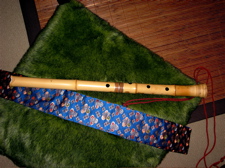 When it comes forth according to intention, or perhaps boldly and mellow with ‘no mind’, my new Miura flute is sounding very beautiful. I have been revising Honshirabe, adapting San’ya [Mountain Valley] and learning Shingetsu, and I have peeked at Koku which has much in common with Shingetsu and San’ya [Mountain Valley]. These are all fairly patient, round, slow pieces that require consideration rather than agility, immense breath control and understanding of the meaning and flow of the music. This might seem obvious to someone who plays Western music but deciphering and discovering further layers of meaning in Honkyoku [Traditional Japanese solo shakuahchi music] can take years, if not a lifetime. I spent four days in the tranquil countryside of my parent’s farm practising. My favourite time is the early morning before the other humans stir and before any domestic sounds commence. Listening for silence reveals how rich the plethora of natural sounds around the lake is: waterfowl, 3 or 4 different kinds of frog, screeching coots, crying lorikeets, black cockatoos, chattering starlings, the reeds in constant motion; occasional cows moo-ing and bulls roaring.
Today, after that, the sound of my 2.1 is growing and sounding more comfortable and the physical familiarisation of the finger position and stretch is fading into insignificance.
Inspired by Ben’s shak-web-blog-travel site http://www.benjisan.blogspot.com/ I have included some more photos of the new shakuhachi on flickr: Benjisan's blogspot and Kyorei's Flickr photos
Thursday, 16 November 2006
Miura 2.1 shakuhachi
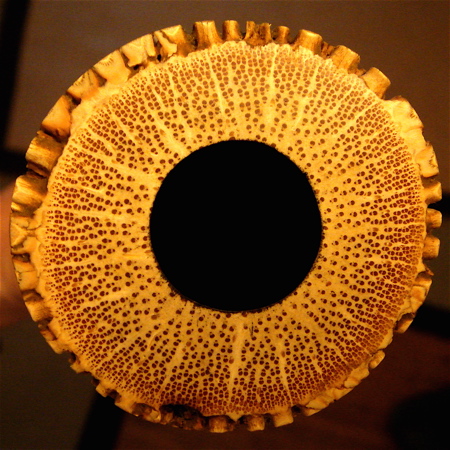


Miura 2.1 shakuhachi Kakizakai had my new 2.1 shakuhachi flute made by Miura Ryuho brought over to Hawaii Shak Festival. Today I started settling into the new finger position and stretch, blowing ro and looking through Shingetsu, which we started learning at Hawaii Shakuhachi Festival under instruction from Furuya Sensei. The instrument is made from a very beautiful, blotched piece of hard bamboo. I am trying hard to be carefully about its humidity in the dry, windy climate we have presently. I also brought back Bronwyn’s 2.4 top joint that had to be repaired after splitting. The 2.4, approximately 2 inches longer than the 1.8 is ‘keyed’ with a fundamental of B rather than D. I am planning to investigate some slower honkyoku pieces on it that benefit from the deep, mellow tone, e.g. Shingetsu, San’ya (3 Valley Yokoyama version), Honshirabe (original piece) and Tamuke [which is intended as a requiem type of piece for ushering in passage from this life to the next). Meanwhile, fast pieces like the agile, fluttery, ostentatious crane piece - Tsuro no Sugomori, high Hifumi Hachigaeshi and intricate San’ya (Mountain Valley) I will continue on 1.8.
Thursday, 9 November 2006
Hawaii Shakuhachi Festival
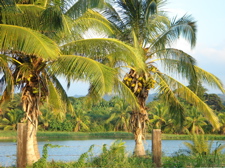 Hawaii University Music Department 9-12 November, Honolulu. Teachers Riley Lee, Stan Richardson, Chris Blasdel and the three Japanese Masters - Furuya, Matama and Kakizakai. With Megumi-san and Kimura on koto. This involved approximately 10 intensive tuition sessions in groups on select repertoire, private lessons and a students' concert and teachers' concert. Some of the repertoire pieces for this year included: Haru no umi, Rokudan, Murasaki Reiho, Shingetsu, Koden Tsugomori, Tone no funa uta + others ...
Photos at KirstyKomuso's Flickr shakuhachi photos tagged 'Hawaii Shakuhachi Festival '06' [or click on photos above in header]


Saturday, 30 September 2006
Country Practice
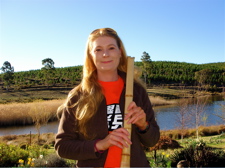 A short visit to Oberon, my parent’s farm, to practise. It was freezing at nights [literally] but beautiful when the wind subsided enough not to interfere with the utaguchi [mouthpiece]. Absolute silence from human noises all around, simply frogs, insects buzzing, cows mooing, birds flittering and chattering and my serene cat listening patiently.
Sunday, 24 September 2006
Opera House Fusion concert
 Riley, Taikoz, a street dancer Japanese rap-style, didgeridoo and Japanese guitarists from fusion tonal pop joined forces for a concert marking the year of Australian-Japanese cultural exchange, in the Sydney Opera House. This was also the day so hot with bush-fires - 34 degrees and very dry - that my 1.6 shakuhachi split in two places.
Friday, 1 September 2006
Komachi Shak Dinner
 Eighteen people attended dinner and the musical soiree of Bronwyn on shakuhachi and Shoko on koto at Komachi Japanese restaurant in Surry Hills. Six of Ben’s friends including Justien and Robert Henke a.k.a Monolake; Judith, Kevin and his wife, Roy and Emily, Joanne and Kota, Hong Jun, Ning, Lara and Theo, Nathan and I. The food was doused in a generous proliferation of bonito flakes but the music was wonderful, if occasionally overwhelmed by the noisy chatty atmosphere and reverberant space. [the image above is from a previous Komachi dinner when Miyama played koto]
Wednesday, 23 August 2006
First Japanese Calligraphy Class
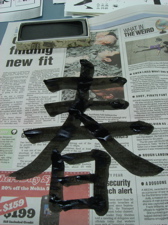 Today I attended the first of my Japanese calligraphy classes at WEA, 5.30pm Wednesday afternoons. Our teacher is Michiko Honda and I joined after learning of the class from Kevin. She knows Riley Lee and Ben Dixon - what a small world.
It was very interesting to be shown the techniques, both by demonstration of the correct stroke style and order and by Michiko individually guiding our hands and supervising the motion. The onsets and little flick-offs or sweep-away brush motions are extremely critical to the balance and beauty of the characters. Pictured below, for example, is haru, the character for spring, appropriate for the current season commencement. It works around the vertical centre in a symmetrical yet flowing design. The three horizontal beams are of different lengths by design but their thickness, too, can be deliberately and aesthetically un-identical in a non-formatted way, i.e. without rules. For most other details - stroke order, rhythm, beginnings and endings - there is a correct form to learn, practise and follow. The two hour class was actually quite relaxing and enjoyable!
For me, the interesting part is observing through practice, the parallels between calligraphy and shakuhachi playing [that numerous wize sages point out as a connection between shakuhachi, shodo, aikido, chado, sumi-e and other traditional art-forms in Japan]: both take immeasurable time to accomplish the grace and power of the inimmitable masters in the tradition; both have various lineages and styles; extreme composure and patience/awareness to blow/brush timelessly slowly leads to a better feeling; the nuances of tapering off, control, stability of breath or brush-stroke; learning forms; both require mind-body awareness and connection; aesthetics of balance and taste; the Zen quality of utter concentration that excludes external intrusions and mind-chatter achieve envelopment.

Sunday, 20 August 2006
Dojo and Ro-buki practising
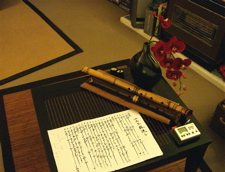 Today, my friends Kevin Melville and Bev came over for ro-buki practice. We had not all practised to a level of confidence between times but it was nice to develop a sense of community. We watched some travel slides, drank genmaicha and ate sembae and rice crackers, etc. from Tokyo Mart at Northbridge. I played Hifumi Hachigaeshi - it was good practice to play with an audience, though still never the same as when privately practising! We watched some of the Yokoyama video lesson. I have set up the new furnishings in my lounge room to achieve a hint of Zen simplicity and sincerity: just the simple bamboo mat, Japanese low table and chair to practice on, and the possibility to sit on tatami cushions on the floor.
Friday, 18 August 2006
Tsugaru Concert Angel Place
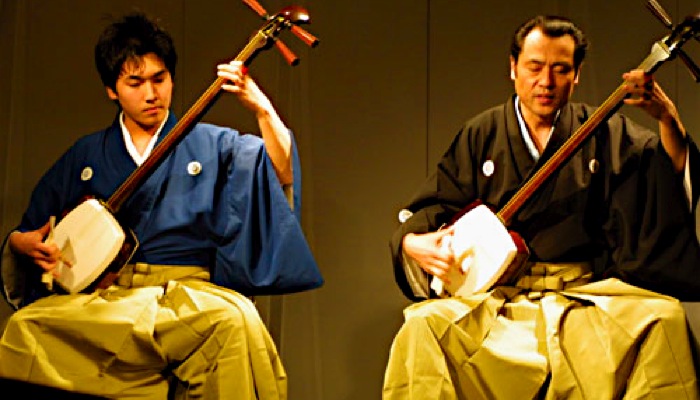 Angel Place - shakuhachi, shamisen and tabla - contemporary multi-cultural fusion concert.
The shakuhachi player had very curious double jointed fingers that appeared very tense for playing and an embouchure that enveloped the end of the flute so that Judith thought he was eating it. The primary shamisen player was quite indulgant-looking, rather absorbed and euphoric in his endeavours but his son seemed sincere, accompanied by a serious koto player and amusing tabla player. Plenty of amusement and an easy-listening predominantly modal and pentatonic concert, not at all traditional.
Thursday, 17 August 2006
Toru Takemitsu book arrived
 The Music of Toru Takemitsu by Peter Burt arrived from Amazon. In particular, the chapter “into the reflection of an Eastern mirror” considers his approach to November Steps for shakuhachi, biwa and orchestra and Autumn for the same combination a couple of years later. I will be looking at the ways in which Takemitsu tried to integrate Western instruments and an inherent tonality and techniques of orchestration with idiomatic writing for the traditional Japanese instruments. This coincides nicely with the DVD Kaoru Kakizakai sent me of his performance of November Steps performed with NHK Symphony Orchestra.
from Wikipedia:
Tōru Takemitsu (武満 徹 Takemitsu Tōru, October 8, 1930–February 20, 1996) was a Japanese composer of music, who explored the compositional principles of Western classical music and his native Japanese tradition both in isolation and in combination. Born in Tokyo, Takemitsu first became interested in western classical music around the time of World War II. He heard western music on American military radio while recuperating from a long illness. He also listened to jazz from his father's ample collection. Takemitsu was largely self-taught in music. He was greatly influenced by French music, and in particular that of Claude Debussy and Olivier Messiaen. In 1951 he founded the Jikken Kobo, a group which introduced many contemporary western composers to Japanese audiences. Takemitsu at first had little interest in traditional Japanese music, but later incorporated Japanese instruments such as the shakuhachi (a kind of bamboo flute) into the orchestra. November Steps (1967), a work for shakuhachi and biwa (a kind of Japanese lute) solo and orchestra was the first piece to combine instruments from east and west. In an Autumn Garden (1973-79) is written for the kind of orchestra that would have played gagaku (traditional Japanese court music). Works such as Eclipse, (1966) for shakuhachi and biwa, Voyage (1973), for three biwas should also been mentioned as works that are decidedly derived from traditional genres. Takemitsu first came to wide attention when his Requiem for string orchestra (1957) was accidentally heard and praised by Igor Stravinsky in 1959 (some Japanese people wanted Igor Stravinsky to hear some tape recorded music by Japanese composers and put in the wrong side of the tape - when they tried to take it out, Stravinsky didn't let them). Stravinsky went on to champion Takemitsu's work. Takemitsu's works include the orchestral piece A Flock Descends Into the Pentagonal Garden (1977), Riverrun for piano and orchestra (1984, the title is the first word in James Joyce's Finnegans Wake), and the string quartet A way a Lone (1981, another piece inspired by Finnegans Wake). He reworked his 1981 piece Toward the Sea (for flute and guitar) twice, once for flute, harp and string orchestra and later again for flute and harp. Chamber music such as Distance de Fee (1951) for violin and piano, or Between tides, for violin, cello and piano, are to be also mentioned. And such jewels of the piano music as Rain tree sketch (1982), Rain Tree Sketch II (1992), Les Yeux Clos (1979) and Les Yeux Clos II (1988) are considered to be amongst the finest works for the instrument written in the twentieth century. He also composed electronic music and almost a hundred film scores for Japanese films including those for Hiroshi Teshigahara's Woman in the Dunes (1964), Akira Kurosawa's Ran (1985) and Shohei Imamura's Black Rain (1989). His first score was for Toshio Matsumoto's Ginrin. His music for cinema rests deeply upon the concept that a new film needs a new sound colour, and is as much about taking out sounds as about taking them in. Some of the formal concepts in Takemitsu's music depend deeply on visual imagery, taken from paintings, dreams, or his concept (about which he writes much) of the garden. Takemitsu died in Tokyo on February 20, 1996. He was posthumously awarded the fourth Glenn Gould Prize in Autumn, 1996.
Further reading
• Peter Burt, The Music of Toru Takemitsu (Cambridge University Press, 2001)
• Noriko Ohtake, Creative sources for the Music of Toru Takemitsu (Ashgate, 1993)
• Toru Takemitsu, Confronting Silence (Fallen Leaf Press, 1995)
Hifumi Hachigaeshi lesson at Ben’s
 Breath control. Intonation fine. Breath control achieved by constant diaphragm pressure will produce higher register and stability of tone and note decay without fragmentation/splitting sound. Practise leaf-decays in ro-buki and longer breaths. Breathe deeply. Initial ornaments beginning phrases should still be more rapid, make sure tsuri glissandi go high enough audibly. At the climax mura-iki section of part 3, close down throat and inner mouth space [rather than raise tongue] and keep lips very loose to achieve airy rough throaty tone quality like Yokoyama’s. Yokoyama’s ornaments on the the high G are with 2, then 2+3, but 1 can sound OK too if hit the hole accurately and completely cover it to change pitch inflection. Ben and I decided it would be interesting to try ‘Japanese-style’ lessons, i.e. listening in on each other’s for the afternoon and learning from the experience and struggles of one-another. In Japan, Kakizakai’s lesson-teaching filled a whole day and students are free to listen for as long as they can. This is a very efficient way to pick up new knowledge and a little nerve-racking performing with such scrutiny so probably helpful practice.
Subscribe to:
Posts (Atom)